Notre-Dame de Paris
The Day of the JackalNotre-Dame de Paris is a cathedral, a planned stop in Charles de Gaulle’s public itinerary, and one of the locations The Jackal examines while searching for a place to attack him. Its approaches offer hiding places but not a workable shot; on the day of the ceremony, the cathedral is instead made into a guarded space where clergy, worshippers, and security forces all move under scrutiny.
Setting and reconnaissance
The Jackal spends a day in the cathedral precincts, taking in the back stairways, alleys, and passages of the surrounding district. Those routes offer concealment and movement, but do not solve the central problem: the cars are parked only a few metres from the cathedral entrance, while the rooftops around the Place du Parvis are too far away for his purpose. The roofs of the tiny adjoining Square Charlemagne are closer, but security forces could easily fill them with watchers. He rejects the site, having found that proximity alone does not make a position useful for an assassination.
This appraisal belongs to a wider search for a firing position that can also offer escape. The Jackal considers the cathedral’s irregular approaches and nearby elevated ground as practical variables, not as guarantees of cover. The same features that might help an attacker hide—a maze of passages or a nearby roof—can be neutralized by distance, exposure, or a security presence.
The cathedral on the itinerary
Notre-Dame is scheduled for the second stop in Charles de Gaulle’s Liberation Day programme. After rekindling the Eternal Flame at the Arc de Triomphe at ten, he is due to attend High Mass at the cathedral at eleven, before travelling to the shrine of the martyred resistants at Mont-Valérien. The schedule is to remain unchanged despite the threat: the President refuses to alter his published engagements.
That decision makes the cathedral a fixed point in a day whose public ceremonies cannot simply be cancelled or moved without revealing the danger. For the police, the question is no longer whether the President will appear, but how to protect him while preserving the announced programme. The cathedral’s ordinary role as a place of worship continues, yet its position in the itinerary subjects every entrance, roofline, and participant to advance security measures.
Security inside and around the cathedral
The precautions extend into spaces normally associated with worship. The Cardinal Archbishop of Paris officiates, flanked by clergy who have been watched while they robe. Two riflemen occupy the organ loft, concealed from even the Archbishop, and plainclothes police mingle with the congregation. They remain alert rather than kneeling or closing their eyes, while the narrative sets their vigilance against the prayer they share with the worshippers: “Please, dear Lord, not while I’m on duty.”
The perimeter reaches beyond the building itself. Nearby rooftops are watched, and people as far as two hundred metres from the cathedral entrance are hustled away when they reach inside their jackets—one to scratch an armpit, another to retrieve a cigarette case. The precautions show how an ordinary gesture can become suspicious when the threat is both concealed and difficult to locate.
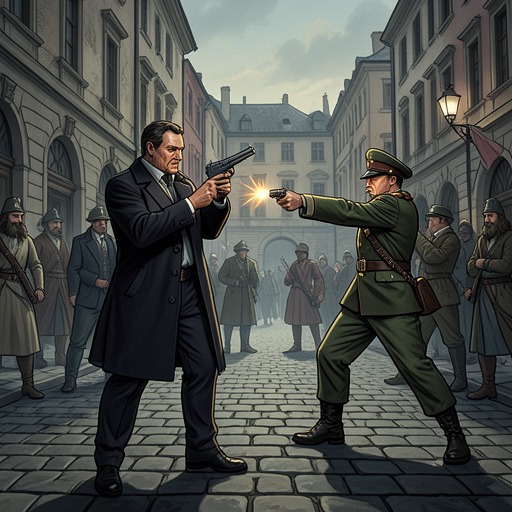
Security also turns inward. Police check one another’s special lapel badges, issued that morning to prevent The Jackal from passing as an officer. A CRS man who loses his badge is arrested, disarmed, and held until colleagues can establish his identity. The episode makes the defensive problem concrete: a disguise can exploit the very institutions deployed to stop it, while heightened vigilance can mistake an actual officer for an infiltrator.
Narrative significance
The Jackal’s rejection of the cathedral and the police’s later occupation of it form a pointed contrast. During reconnaissance, the location is measured as a possible route to the target and found wanting; during the ceremony, it becomes a dense apparatus of surveillance, with armed observers hidden among the architecture and the congregation. The building is not merely a backdrop to the pursuit: its thresholds and sightlines determine what an attacker might attempt and what defenders must watch.
The service passes without a shot or an explosion. That quiet outcome does not resolve the danger; it marks one stage in a day of repeated public appearances, each met by extraordinary precautions. At Notre-Dame, the sacred routine continues under an unseen security order, and the tension comes from the gap between a ceremony proceeding as planned and the possibility that any concealed person, movement, or identity might overturn it.